Every day on hire billed. Every unit in sight.
For cranes and heavy machinery, manlifts, generators and light towers, scaffolding and formwork, trucks and buses — owned, cross-hired or leased, across all your branches and yards.
Before and after
The daily work of a rental company, on spreadsheets and chats — and the same work in Erpzo.
Off-hire given by phone; the unit keeps running in nobody's sheet, or stops being billed too early.
Rent runs from dispatch to the written off-hire, by your rules (month length, day of return, breakdowns).
Unbilled days, disputes
Operator hours and overtime on paper, typed late or never.
The client signs the hours on the phone; approved hours and overtime go straight onto the invoice.
Unbilled overtime
Damage and missing scaffolding noticed at the yard, forgotten by invoice time.
The return note records damage and shortages; they are charged on the next invoice.
Repairs and losses recovered
Invoices made at month end from several sheets, often late.
One invoice run for every contract, proforma, VAT, statements and ageing.
Cash in sooner, days of work saved
No live picture of what is on rent, idle or in the workshop.
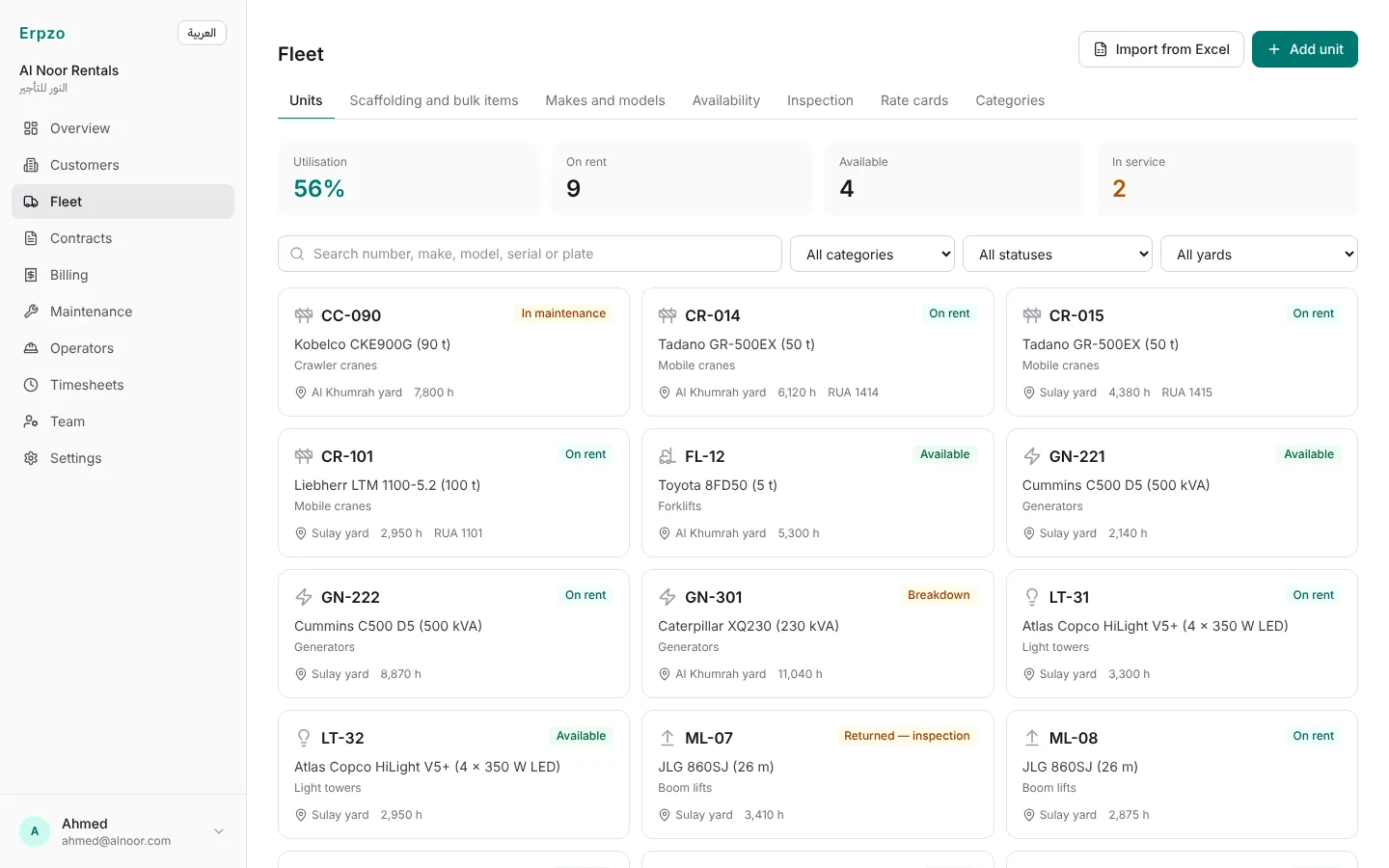
Fleet status, utilisation and an availability calendar on one screen.
Idle units found and rented
Two salesmen promise the same crane.
A unit can be on one contract at a time; swaps and returns update it at once.
No double bookings
A TPI certificate, Istimara or insurance expires on site.
Expiry alerts before the date; units with expired papers are flagged.
Stopped machines, fines
Services done from memory.
Service schedules by hours or km, breakdowns and work orders with parts and labour.
Breakdowns on hire, repair costs
Customers keep hiring beyond their credit.
Credit limit check before a contract starts; over the limit needs a manager's approval.
Bad debt
Discounts given freely by phone.
Prices from the rate card; deeper discounts need a manager's approval before the quote goes out.
Margin kept
What is inside
Fleet and availability
Every unit with its status, meter, documents and history; scaffolding counted by quantity in each yard; utilisation and an availability calendar.
Quotes and contracts
Rate card and customer prices, discount approval, credit check, deposits, units reserved on the contract.
Deliveries, swaps, returns
Delivery notes signed on the phone with photos, off-hire, swaps, returns with inspection, damage and missing pieces.
Billing your way
Day, week, month or hourly; 30-day or calendar months; best rate; minimum hire; in advance or in arrears; proforma, credit notes, payments, statements, ageing.
Workshop and compliance
Service plans by hours or km, breakdowns with rent paused, work orders with parts and labour, inspection after return, document expiry alerts.
Operators and timesheets
Operators with licences and cards; hours on the phone signed by the site supervisor; overtime billed from approved hours.
Your rules, not ours
Every rental company bills a little differently. In Settings → Rules you choose how a month is counted, when rent starts and stops, whether the return day is charged, whether a breakdown pauses rent, how overtime is counted, when invoices go out and more. Each contract keeps the rules it started with.
See it with your own eyes
Open a demo company now — no sign-up, nothing to install.